From BioEdge: "After Dobbs, abortion needs ethicists, not Twitter heroes"
Showing posts with label abortion. Show all posts
Showing posts with label abortion. Show all posts
Monday, August 22, 2022
Friday, July 29, 2022
Tuesday, July 05, 2022
Saturday, May 28, 2022
Yes, all bioethicists should engage abortion ethics, but who would be interested in what they have to say?

Yes, all bioethicists should engage abortion ethics, but who would be interested in what they have to say?
Open peer commentary, now here: (2022) Yes, All Bioethicists Should Engage Abortion Ethics, but Who Would Be Interested in What They Have to Say?, The American Journal of Bioethics, 22:8, 33-36, DOI: 10.1080/15265161.2022.2089274 [PDF of final version here]
1500 words.
Friday, April 29, 2022
Trent Horn on Abortion: Persuasive "Pro-Life"?
Responses to Trent Horn on abortion; videos and text below.
Sunday, November 07, 2021
Micro-Digressions: A Philosophy Podcast -- SPECIAL EPISODE: Debating abortion
I was on Spencer Case's "Micro-Digressions: A Philosophy Podcast" @ADigressions to discuss abortion and ethics, and even the law too, with Christopher Kaczor.
https://www.buzzsprout.com/956725/9408417-special-episode-debating-abortion
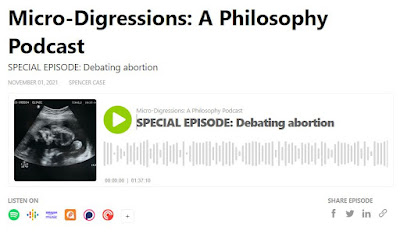
A few recollections about this discussion below the fold:
Sunday, January 24, 2021
Monday, November 16, 2020
Abortion Ethics Blog Post Archive
Here is an archive of the blog posts written after the publication of Thinking Critically About Abortion. Many of these posts are inspired by observations about how people often engage the issues, other posts discuss further arguments, and other posts recommend other readings and resources.
Please click on the link for the current version of this document!
Tuesday, July 21, 2020
Is Your Opinion on Abortion Wrong? Critical Thinking and Abortion
Kristina Grob, Philosophy, University of South Carolina Sumter, and Nathan Nobis, Philosophy, Morehouse College, Atlanta, GA.
But who is right here? Should abortion be generally legal or should it be banned? Is it usually immoral or is it usually not wrong at all? These same questions, of course, are asked in other countries.
To many people, answers to these questions seem obvious, and people with different or contrary answers are, well, just wrong.
But how can we know? In particular, could anyone know that abortion is not wrong and should be legal? If so, how? And how would anyone effectively, persuasively, communicate that knowledge?
One important set of answers depends on this idea: critical thinking. Critical thinking can help people know, not merely believe or feel, that their perspectives on issues are true or correct, and it can help them persuade others to understand and accept that knowledge.
We are philosophy professors who teach courses in critical thinking and its applications to ethical, political, scientific, and legal issues. In our 2019 open-access book, Thinking Critically About Abortion: Why Most Abortions Aren’t Wrong & Why All Abortions Should be Legal, we apply well-confirmed methods of critical thinking to the most discussed arguments about abortion.
Critical thinking can be operationalized as skills. Three key critical thinking skills involve defining words, identifying the structures of arguments, and evaluating explanations. Understanding these and other critical thinking skills can only help improve conversations and advocacy about abortion. Let’s see them in action.
Also posted at Science and Philosophy, Medium’s centre for scientifically-informed content.
 |
| People with "thought bubbles" over their heads, suggestive of opinions. |
For the past few years in the United States, almost daily there’s a headline about new proposed abortions restrictions. Conservatives cheer, liberals despair.
But who is right here? Should abortion be generally legal or should it be banned? Is it usually immoral or is it usually not wrong at all? These same questions, of course, are asked in other countries.
To many people, answers to these questions seem obvious, and people with different or contrary answers are, well, just wrong.
But how can we know? In particular, could anyone know that abortion is not wrong and should be legal? If so, how? And how would anyone effectively, persuasively, communicate that knowledge?
One important set of answers depends on this idea: critical thinking. Critical thinking can help people know, not merely believe or feel, that their perspectives on issues are true or correct, and it can help them persuade others to understand and accept that knowledge.
We are philosophy professors who teach courses in critical thinking and its applications to ethical, political, scientific, and legal issues. In our 2019 open-access book, Thinking Critically About Abortion: Why Most Abortions Aren’t Wrong & Why All Abortions Should be Legal, we apply well-confirmed methods of critical thinking to the most discussed arguments about abortion.
 |
| "Thinking Critically About Abortion" book cover. |
Critical thinking can be operationalized as skills. Three key critical thinking skills involve defining words, identifying the structures of arguments, and evaluating explanations. Understanding these and other critical thinking skills can only help improve conversations and advocacy about abortion. Let’s see them in action.
Saturday, April 25, 2020
Thank you notes!
Philipp Schulz has a blog post on "Practicing Academic Kindness in the Classroom" that offers the great suggestion of having students write "thank you" notes to authors of writings they read in class that the students appreciated: perhaps the reading changed their mind, helped them articulate a belief, presented an opposing view in an interesting light or anything else the student found valuable.
A philosophy professor friend of mine, or his TA, had students do this in their class and some students kindly wrote about how they appreciated my "Early and Later Abortions" and "Reply to Tollefsen" in Bob Fischer, ed., Ethics, Left and Right: The Moral Issues That Divide Us (Oxford University Press, 2019). (This chapter led to another chapter, which led to the Thinking Critically About Abortion book).
It is, of course, very rewarding for me to know that someone read and enjoyed my writings and it helped them, they believe, think better about a complex and controversial issue. With permission and pride, I'm sharing their reactions below.

A philosophy professor friend of mine, or his TA, had students do this in their class and some students kindly wrote about how they appreciated my "Early and Later Abortions" and "Reply to Tollefsen" in Bob Fischer, ed., Ethics, Left and Right: The Moral Issues That Divide Us (Oxford University Press, 2019). (This chapter led to another chapter, which led to the Thinking Critically About Abortion book).
It is, of course, very rewarding for me to know that someone read and enjoyed my writings and it helped them, they believe, think better about a complex and controversial issue. With permission and pride, I'm sharing their reactions below.

Sunday, March 22, 2020
Videos on Arguments about Abortion
Here are some videos that review a PowerPoint presentation on arguments about abortion that was recently developed for teaching purposes; the slides are the bottom of the page. These are also posted at AbortionArguments.com.
Introduction and Defining Abortion:
Question-Begging Arguments about Abortion
Common, "Everyday" Arguments about Abortion:
Arguments that Abortion is Prima Facie Wrong:
Arguments that Abortion is Prima Facie Permissible and Conclusions:
PowerPoint slides:
These slides in PDF.
Introduction and Defining Abortion:
Question-Begging Arguments about Abortion
Common, "Everyday" Arguments about Abortion:
Arguments that Abortion is Prima Facie Wrong:
Arguments that Abortion is Prima Facie Permissible and Conclusions:
PowerPoint slides:
These slides in PDF.
Sunday, January 05, 2020
"Impossible Conversations"
Here is another attempt for the "Impossible Conversations" project or competition; click on the title for the link to the letters:
Friday, December 13, 2019
"When does life begin?" and "Are fetuses human?": Two bad questions to ask about abortion
I was inspired to write up some reactions to something I recently read. I posted them here:

"'When does life begin?' and 'Are fetuses human?': Two bad questions to ask about abortion

Thursday, October 24, 2019
"Impossible Conversations"


Friday, July 26, 2019
Abortion and Soundbites: Why Pro-Choice Arguments Are Harder to Make
New! "Abortion and Soundbites: Why Pro-Choice Arguments Are Harder to Make" in Areo Magazine!
Areo has unfortunately closed; the text of this article is below.

"Soundbites," argue @NathanNobis and Kristina Grob, "make many pro-life arguments seem stronger than they really are, while the complexities of pro-choice arguments can't be readily reduced to soundbites."https://t.co/cry2DlKtyt
— Areo (@AreoMagazine) July 23, 2019
Abortion and
Soundbites: Why Pro-Choice Arguments Are Harder to Make
7 minute read
By Nathan Nobis and Kristina Grob
Arguments are nowadays
often presented as soundbites: as slogans, tweets, memes and even gifs.
Arguments developed in detail often meet the response TL;DR (Too
Long, Didn’t Read). This is unfortunate—especially when tackling the topic
of abortion. Soundbites make many pro-life arguments seem stronger than they
really are, while the complexities of pro-choice arguments can’t be readily
reduced to soundbites.
Pro-Life Soundbites
Abortion is wrong because:
- fetuses are human or human
beings.
- human beings have rights.
- human rights protect all
humans.
- we should advocate for equality,
including equality for unborn human beings.
- abortion ends a life.
- abortion is killing.
These soundbites can sound
good because human beings are generally wrong to kill; human
rights do protect human beings; human rights apply to all humans;
equality is a good thing; and ending lives and killing are often
wrong. Denying these things often results in silly assertions: that fetuses in
human women aren’t human or aren’t alive, or that abortion doesn’t involve
killing, etc.
That these soundbites are
based on what seems to be common sense can make these simple cases against
abortion seem strong.
Pro-Choice Presentations
Presentations of pro-choice
perspectives often begin with abstractions:
- What does human mean?
Does everything human have rights?
- Why do human beings have
rights? What makes humans have rights?
- Do human rights really protect
everything and everyone that is human, or all human beings?
- Do basic human rights include a
right to someone else’s body? How could someone gain that right? What kind
of rights to assistance do human rights entail?
- Denying equality among human
beings is very bad, but is equality sometimes inappropriate or even wrong?
What does equality mean?
- When is killing not wrong?
Does killing ever raise few, if any, moral issues whatsoever?
Since pro-choice positions
depend on more precise and complex theoretical thinking, they are harder to
effectively communicate—especially when audiences and discussion partners will
not—or cannot—seek to understand more deeply and carefully.
Pro-Choice Soundbites
Consider some common
pro-choice soundbites:
- My body, my choice.
- A woman can do whatever she
wants with her own body.
- People who oppose abortion just
want to control women.
- If you’re against abortion,
don’t have one.
- Abortion is just a medical
procedure.
- Abortion is a personal choice.
- Every child a wanted child.
- Abortion is not up for debate.
The problems with these
soundbites are obvious to anyone who doesn’t already accept them.
- No. You cannot choose to use
your body to murder someone.
- No. You cannot do everything
you want with your own body: you cannot murder someone.
- No. If women are doing
something that should be illegal, they should be controlled, just as
anyone else should.
- No. You wouldn’t say Against
child abuse? Then don’t abuse children! so this response is
foolish.
- No. If abortion is wrong, it’s
not a mere medical procedure.
- No. We can’t or shouldn’t make
certain personal choices, if those choices are profoundly wrong.
- No. That a child is unwanted
wouldn’t entitle anyone to kill that child.
- No, abortion is up for debate.
What do you think we are doing in talking about it?
Not every pro-choice
soundbite generates these reactions, but many do. Pro-choice soundbites just
don’t have the same initial plausibility as pro-life soundbites.
Critiques of Pro-Life Soundbites
Pro-choice critics don’t
argue that pro-life soundbites are completely wrong.
Pro-choicers argue that, if we look at the details, their initial plausibility
fades: thinking them through reveals that the ideas don’t have the implications
their advocates think they do.
- If human means biologically
human, that means that random human cells and tissues have rights,
which they don’t. So just because fetuses are biologically human doesn’t
mean they have rights.
- We can ask why human beings
have rights: why do rocks and vegetables not have rights? A
long-influential family of theories of rights proposes that we have rights
because we are conscious and feeling beings. This theory suggests that
pre-conscious embryos and early fetuses don’t have rights.
- While people say that all human
beings have rights, they don’t. Human corpses don’t have rights.
Brain-dead human beings do not have the rights we have: letting their
bodies die would be wrong if they had, say, the right to life. Babies born
missing most of their brains seem to not have the rights that regular
babies have: it’s hard to see why letting them die, even when they could
be kept alive, would be wrong, since being alive does them no good. Not
all human beings have features that rights are supposed to protect, so it
seems that not all human beings have rights. So just because fetuses are
human beings doesn’t, in itself, mean they have rights.
- The right to life is not a
right to everything someone needs to live—especially someone else’s body.
Explaining if, how and why a fetus would have a right to a pregnant
woman’s body is a challenge.
- Denying equality among humans
is very bad. But advocating for equality between human beings and, say,
isolated human cells or organs (or plants or bacteria) would be wrong. And
what does equal mean? Not everything is equal: there is
such a thing as justified, reasonable discrimination: there might be good
reasons to deny that human embryos and early fetuses are equal to us.
- Killing random cells, bacteria,
plants, etc. is often not wrong at all. There is killing that’s wrong and
killing that isn’t wrong: just because abortion is killing doesn’t mean
it’s wrong.
Identifying these problems
requires showing that things are more complicated than they seem. It requires
seeing that some common ways of understanding aren’t quite correct and might
even be harmful.
There are, of course, more
sophisticated arguments against abortion. These often appeal to claims about
human embryos and fetuses’ essence or essential properties,
their rational natures and their being the same kind of
beings that we are. These abstract claims and arguments are harder to evaluate.
However, close critical examination reveals that these abstract arguments do
not succeed: they raise more questions than they answer.
Critical Thinking and Abortion
Developing strong critical
thinking skills requires training and practice.
In our recent short,
introductory, open-access book on abortion, Thinking Critically About Abortion: Why Most
Abortions Aren’t Wrong & Why All Abortions Should be Legal, we review a lot of bad
arguments and ways of understanding abortion, from all sides. Our main positive
arguments for pro-choice perspectives, briefly stated, are these.
- It is wrong to kill adults,
children and babies because they are conscious, aware and have feelings.
Since early fetuses entirely lack these characteristics, it is not
inherently wrong to kill them, so most abortions are not morally wrong,
since most abortions are done early in pregnancy, before consciousness and
feeling develop in the fetus.
- Furthermore, since the right to
life does not include the right to someone else’s body, a fetus might not
have the right to the pregnant woman’s body—therefore she has the right to
not allow the fetus use of her body. This further justifies abortion, at least
until technology allows for the removal of fetuses to other wombs. Since
morally permissible actions should be legal, abortions should be legal: it
is an injustice to criminalize actions that are not wrong.
These arguments are not
new, but they are new to most people, since most people are not familiar with
the philosophical literature on abortion. Versions of these are likely to be
the best arguments for
pro-choice perspectives out there.
Soundbite-Free Advocacy
So, what can a pro-choice
advocate do? Here are some ideas:
- Don’t provide soundbites.
You’re better off saying nothing than giving what sounds like a bad
argument—perhaps because it is a bad argument.
- Very clever and creative people
could develop good pro-choice soundbites. These are likely to be based on
abstract and theoretical considerations. But developing any such
soundbites in an echo-chamber, with little reflection on how they would be
received by the outside world, is a strategy for failure.
- Denying that the issues can be
reduced to soundbites might do some good: acknowledging complexity can
help.
- We’d all like to engage and
persuade everyone, but it might be best to focus on people who are able
and willing to engage complexity: judges and legal officials are generally
able and willing to do that; elected politicians are less likely to.
Focusing on audiences willing to listen and productively discuss would
reduce discouragement and frustration. Many people are well-meaning and
willing to engage the issues in serious, respectful and responsible ways.
But these discussions aren’t likely to be fruitful if they appeal to
soundbites.
This isn’t about persuasion
in the sense of manipulation, public relations or anything that could be
called sophistry. We want to move people towards reasonable,
justified messages.
While pro-life soundbites
often move people, they do not seem to move people towards views that are
ultimately justified by strong evidence and arguments: we believe this can be
demonstrated by reasoning rigorously, patiently and critically about those
arguments. Our book’s subtitle is Why Most Abortions Aren’t Wrong &
Why All Abortions Should be Legal because we believe that critical
thinking reveals that this view is supported by better arguments than its
opposite. Soundbites don’t help show that, to most people. We need to find out
what will.
Nathan
Nobis is is an Associate Professor of Philosophy at Morehouse College, in
Atlanta, Georgia, USA. He has authored and co-authored many articles, essays,
reviews and a few books on topics in ethics and philosophy.
Kristina Grob is an Assistant Professor of Philosophy at the University of South Carolina Sumter. Each semester she shows students that philosophy can be a way of life, no matter their day jobs.
Thursday, June 27, 2019
Thinking Critically About Abortion
New!
Thinking Critically About Abortion:
Why Most Abortions Aren’t Wrong &
Why All Abortions Should Be Legal
Why All Abortions Should Be Legal
by Nathan Nobis & Kristina Grob, Open Philosophy Press
An Open Educational Resource
Freely available at www.AbortionArguments.com

This book introduces readers to the many arguments and controversies concerning abortion. While it argues for ethical and legal positions on the issues, it focuses on how to think about the issues, not just what to think about them. It is an ideal resource to improve your understanding of what people think, why they think that and whether their (and your) arguments are good or bad, and why. It's ideal for classroom use, discussion groups, organizational learning, and personal reading.
This open educational resource is freely available in PDF, full text, Google Doc, ePub, Mobi, and other formats.
It's also a $5.38 paperback, which can be ordered and shipped to anyone who would benefit from it: governmental representatives and other elected officials, organizational leaders and community activists, thought leaders and influencers, leaders of religious organizations, friends and family and anyone else who would benefit from a thorough assessment of arguments on all sides of the abortion debates. (Why $5.38? This is currently the lowest price Amazon would allow). It's also a Kindle book for $.99 (or free), which can be shared and sent also.
About this Book
From the Preface
To many people, abortion is an issue for which discussions and debates are frustrating and fruitless: it seems like no progress will ever be made towards any understanding, much less resolution or even compromise.
Judgments like these, however, are premature because some basic techniques from critical thinking, such as carefully defining words and testing definitions, stating the full structure of arguments so each step of the reasoning can be examined, and comparing the strengths and weaknesses of different explanations can help us make progress towards these goals.
When emotions run high, we sometimes need to step back and use a passion for calm, cool, critical thinking. This helps us better understand the positions and arguments of people who see things differently from us, as well as our own positions and arguments. And we can use critical thinking skills help to try to figure out which positions are best, in terms of being supported by good arguments: after all, we might have much to learn from other people, sometimes that our own views should change, for the better.
Here we use basic critical thinking skills to argue that abortion is typically not morally wrong. We begin with less morally-controversial claims: adults, children and babies are wrong to kill and wrong to kill, fundamentally, because they, we, are conscious, aware and have feelings. We argue that since early fetuses entirely lack these characteristics, they are not inherently wrong to kill and so most abortions are not morally wrong, since most abortions are done early in pregnancy, before consciousness and feeling develop in the fetus.
Furthermore, since the right to life is not the right to someone else’s body, fetuses might not have the right to the pregnant woman’s body—which she has the right to—and so she has the right to not allow the fetus use of her body. This further justifies abortion, at least until technology allows for the removal of fetuses to other wombs. Since morally permissible actions should be legal, abortions should be legal: it is an injustice to criminalize actions that are not wrong.
In the course of arguing for these claims, we:
In the course of arguing for these claims, we:
- discuss how to best define abortion;
- dismiss many common “question-begging” arguments that merely assume their conclusions, instead of giving genuine reasons for them;
- refute some often-heard “everyday arguments” about abortion, on all sides;
- explain why the most influential philosophical arguments against abortion are unsuccessful;
- provide some positive arguments that at least early abortions are not wrong;
- briefly discuss the ethics and legality of later abortions, and more.
This essay is not a “how to win an argument” piece or a tract or any kind of apologetics. It is not designed to help anyone “win” debates: everybody “wins” on this issue when we calmly and respectfully engage arguments with care, charity, honesty and humility. This book is merely a reasoned, systematic introduction to the issues that we hope models these skills and virtues. Its discussion should not be taken as absolute “proof” of anything: much more needs to be understood and carefully discussed—always.
Advanced Praise
Wednesday, May 29, 2019
Open Access (OER) Ethics Textbook
Here's a new open-access ethics textbook with three essays by, me and me and a co-author, in it.

UNIT TWO: TORTURE, DEATH, AND THE “GREATER GOOD”
7 The Ethics of Torture (Martine Berenpas)
8 What Moral Obligations do we have (or not have) to Impoverished Peoples? (B.M. Wooldridge)
9 Euthanasia, or Mercy Killing (Nathan Nobis)
10 An Argument Against Capital Punishment (Noah Levin)
11 Common Arguments about Abortion (Nathan Nobis & Kristina Grob)
12 Better (Philosophical) Arguments about Abortion (Nathan Nobis & Kristina Grob)
UNIT THREE: PERSONS, AUTONOMY, THE ENVIRONMENT, AND RIGHTS
13 Animal Rights (Eduardo Salazar)
14 John Rawls and the “Veil of Ignorance” (Ben Davies)
15 Environmental Ethics: Climate Change (Jonathan Spelman)
16 Rape, Date Rape, and the “Affirmative Consent” Law in California (Noah Levin)
17 The Ethics of Pornography: Deliberating on a Modern Harm (Eduardo Salazar)
18 The Social Contract (Thomas Hobbes)
UNIT FOUR: HAPPINESS
19 Is Pleasure all that Matters? Thoughts on the “Experience Machine” (Prabhpal Singh)
20 Utilitarianism (J.S. Mill)
21 Utilitarianism: Pros and Cons (B.M. Wooldridge)
22 Existentialism, Genetic Engineering, and the Meaning of Life: The Fifths (Noah Levin)
23 The Solitude of the Self (Elizabeth Cady Stanton)
24 Game Theory, the Nash Equilibrium, and the Prisoner’s Dilemma (Douglas E. Hill)
UNIT FIVE: RELIGION, LAW, AND ABSOLUTE MORALITY
25 The Myth of Gyges and The Crito (Plato)
26 God, Morality, and Religion (Kristin Seemuth Whaley)
27 The Categorical Imperative (Immanuel Kant)
28 The Virtues (Aristotle)
29 Beyond Good and Evil (Friedrich Nietzsche)
30 Other Moral Theories: Subjectivism, Relativism, Emotivism, Intuitionism, etc. (Jan F. Jacko)
https://www.ngefarpress.com/2019/05/introduction-to-ethics-open-educational.html
- "Euthanasia, or Mercy Killing" by Nathan Nobis
- “Common Arguments about Abortion” and “Better (Philosophical) Arguments about Abortion,” by Nathan Nobis and Kristina Grob, [both chapters].
UNIT ONE: INTRODUCTION TO CONTEMPORARY ETHICS: TECHNOLOGY, AFFIRMATIVE ACTION, AND IMMIGRATION
1 The “Trolley Problem” and Self-Driving Cars: Your Car’s Moral Settings (Noah Levin)
2 What is Ethics and What Makes Something a Problem for Morality? (David Svolba)
3 Letter from the Birmingham City Jail (Martin Luther King, Jr)
4 A Defense of Affirmative Action (Noah Levin)
5 The Moral Issues of Immigration (B.M. Wooldridge)
6 The Ethics of our Digital Selves (Noah Levin)
1 The “Trolley Problem” and Self-Driving Cars: Your Car’s Moral Settings (Noah Levin)
2 What is Ethics and What Makes Something a Problem for Morality? (David Svolba)
3 Letter from the Birmingham City Jail (Martin Luther King, Jr)
4 A Defense of Affirmative Action (Noah Levin)
5 The Moral Issues of Immigration (B.M. Wooldridge)
6 The Ethics of our Digital Selves (Noah Levin)
UNIT TWO: TORTURE, DEATH, AND THE “GREATER GOOD”
7 The Ethics of Torture (Martine Berenpas)
8 What Moral Obligations do we have (or not have) to Impoverished Peoples? (B.M. Wooldridge)
9 Euthanasia, or Mercy Killing (Nathan Nobis)
10 An Argument Against Capital Punishment (Noah Levin)
11 Common Arguments about Abortion (Nathan Nobis & Kristina Grob)
12 Better (Philosophical) Arguments about Abortion (Nathan Nobis & Kristina Grob)
UNIT THREE: PERSONS, AUTONOMY, THE ENVIRONMENT, AND RIGHTS
13 Animal Rights (Eduardo Salazar)
14 John Rawls and the “Veil of Ignorance” (Ben Davies)
15 Environmental Ethics: Climate Change (Jonathan Spelman)
16 Rape, Date Rape, and the “Affirmative Consent” Law in California (Noah Levin)
17 The Ethics of Pornography: Deliberating on a Modern Harm (Eduardo Salazar)
18 The Social Contract (Thomas Hobbes)
UNIT FOUR: HAPPINESS
19 Is Pleasure all that Matters? Thoughts on the “Experience Machine” (Prabhpal Singh)
20 Utilitarianism (J.S. Mill)
21 Utilitarianism: Pros and Cons (B.M. Wooldridge)
22 Existentialism, Genetic Engineering, and the Meaning of Life: The Fifths (Noah Levin)
23 The Solitude of the Self (Elizabeth Cady Stanton)
24 Game Theory, the Nash Equilibrium, and the Prisoner’s Dilemma (Douglas E. Hill)
UNIT FIVE: RELIGION, LAW, AND ABSOLUTE MORALITY
25 The Myth of Gyges and The Crito (Plato)
26 God, Morality, and Religion (Kristin Seemuth Whaley)
27 The Categorical Imperative (Immanuel Kant)
28 The Virtues (Aristotle)
29 Beyond Good and Evil (Friedrich Nietzsche)
30 Other Moral Theories: Subjectivism, Relativism, Emotivism, Intuitionism, etc. (Jan F. Jacko)
Saturday, April 27, 2019
Response to "Nathan Nobis' Summary of Pro-Choice Arguments"
Someone wrote a response to my 1000-Word Philosophy essay on abortion, entitled "Nathan Nobis' Summary of Pro-Choice Arguments." I wrote brief a reply and twice posted it on their blog, but it twice "disappeared" (. . but it might have returned, so I really don't know whether it's posted or not), so I post this reply here since I did take the time to write it up.
See below the fold, please.

See below the fold, please.


Subscribe to:
Posts (Atom)